

There’s a version of buying a home that doesn’t get talked about enough—and it’s where most people spend the longest time.
It’s not the search.
It’s not the closing.
It’s the stretch in between, where you’re almost ready.
You’ve looked at homes. You’ve run the numbers. You probably have a sense of what would work for your life. But instead of moving forward, you’re waiting—for a better rate, a clearer sign, or a moment where the decision feels easier.

And to be clear, that instinct isn’t wrong.
Most buyers in Sioux Falls aren’t rushing into anything. They’re trying to be thoughtful, make a smart financial move, and avoid regret.
But what often gets overlooked is this: waiting isn’t neutral. It’s a decision—with its own set of tradeoffs.
Waiting for the “Right” Rate Comes With Its Own Risk
Interest rates matter. There’s no way around that.
They shape your monthly payment and influence long-term affordability, so it makes sense that many buyers are watching closely and hoping for a better number before making a move.
The challenge is how rates actually behave.
They don’t drop in one clean, predictable shift. Historically, meaningful changes in mortgage rates take time—often months, or even years—and even then, they tend to move in cycles. Small dips are usually followed by increases, sometimes multiple times, before settling into a new range.
In other words, the scenario where rates fall quickly from the mid-6% range into the 5s and stay there long enough for everyone to act at once is unlikely. And when rates do improve, it rarely happens in isolation.
More buyers re-enter the market. Demand increases. Inventory tightens. And suddenly, the home you were considering isn’t as available—or as flexible—as it was before.
This is where many buyers get stuck without realizing it: you’re not just waiting for a better rate—you’re accepting uncertainty in everything else.
What will prices look like when rates drop?
How much more competition will there be?
Will the home you passed on still be an option?
You don’t get to combine yesterday’s opportunity with tomorrow’s rate.
That doesn’t mean rushing into something that doesn’t make sense. But it does mean looking at the full picture. Many buyers today are finding ways to structure deals that work in the present—through seller credits, temporary buydowns, or selecting move-in-ready homes where pricing and timelines are more predictable—instead of trying to time a moment that may not arrive the way they expect.
Overthinking Isn’t Protecting You—It’s Slowing You Down
For some buyers, it’s not about rates at all. It’s about finding the right home.
And when you’re making one of the biggest financial decisions of your life, that pressure is real. You want to feel confident. You want to know you’re making the best possible choice.
So you keep looking.
And comparing.
And second-guessing.
At a certain point, though, more options stop being helpful.
They start making the decision harder.
When you’re comparing homes that vary widely in layout, age, condition, and maintenance risk, it becomes nearly impossible to feel confident in any one direction. You’re not just choosing a home—you’re trying to solve for every possible unknown at the same time.
That’s where many buyers unknowingly shift from being thoughtful to being stuck.
But here’s the important distinction: moving forward doesn’t mean settling.
It means getting clear on what actually matters for your life and filtering out everything that doesn’t.
This is where having the right guidance—and the right type of inventory—changes the experience.
Instead of sorting through endless variations, many buyers find clarity when they step into homes that are already designed around how people live today. In new construction communities, floor plans tend to be refined, layouts intentional, and the condition of the home isn’t a variable you have to solve for.
That doesn’t make the decision automatic. But it does make it clearer.
And for most buyers, clarity—not perfection—is what finally allows them to move forward with confidence.
“We’re Just Not Ready Yet” Usually Isn’t About Timing
This is the most common—and most reasonable—place to land.
Life is busy. Things are changing. Maybe work feels uncertain, or you’re waiting for the next phase to settle before taking on something new.
So you tell yourself you’ll revisit the idea later.
And sometimes, that’s exactly the right call.
But often, what’s actually happening is this: you’re waiting for a version of life that feels completely settled before making a decision that would help create that stability.
The reality is, that moment rarely shows up all at once.
There will always be something in motion. Something that could feel more certain. Something that could be timed better.
At the same time, a lot of this hesitation is tied to what buying a home used to mean—especially when it came with unknowns like unexpected repairs, aging systems, or ongoing maintenance costs.
And those concerns are valid. Industry data shows that roughly one in three homeowners faces an unexpected repair of $1,000 or more each year, particularly in older homes.
But not every path carries that same level of uncertainty.
With newer homes, especially move-in-ready options, many of those variables are addressed upfront. Systems are new. Materials are current. Maintenance isn’t immediate.
So for many buyers, the hesitation isn’t just about whether they’re ready.
It’s about whether the type of home they’re considering aligns with the level of certainty they’re looking for.
Think You Missed Your Window? Not So Fast.
A lot of buyers carry this quietly:
“I should’ve bought when rates were lower.”
“We probably missed the best opportunity.”
And once that thought sets in, it can keep you on the sidelines longer than necessary.
But here’s the part worth reconsidering: the opportunity didn’t disappear—it just changed shape.
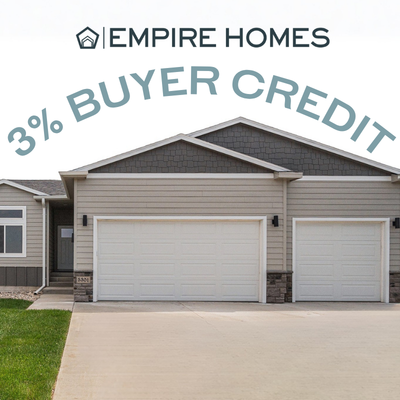
Right now, many buyers are using incentives to bridge the gap between where rates are and where they wish they were. One of the most effective ways to do that is through seller credits—like the 3% offered on Empire homes—which can be applied toward closing costs, rate buydowns, or upfront expenses.
In real terms, that can significantly shift your monthly payment or reduce the cash needed to get into a home.
So instead of trying to rewind the market back to a moment that’s already passed, the better question becomes: what tools are available today to make this work now?
Because in many cases, the numbers aren’t as far off as they feel—they just need to be structured differently.
Almost Ready Is Usually Closer Than You Think
If you’ve been in that “almost” space for a while, you’re not doing anything wrong.
You’re being intentional. You’re thinking it through. You’re trying to make a decision you won’t regret.
But at a certain point, waiting stops adding clarity—and starts delaying it.
Because most of what you’re trying to figure out doesn’t get solved in your head.
It gets solved in conversation.
Not a commitment.
Not a contract.
Just a real look at what your options actually are right now.
What’s available.
What’s realistic.
And what would actually work for your life—not just in theory, but in practice.
Because for most buyers, the shift from “almost ready” to “ready” doesn’t come from a perfect moment.
It comes from finally seeing the full picture clearly enough to move forward.